Concrete Retaining Wall Blocks: Top 3 Types
Why Concrete Retaining Wall Blocks Are Your Go-To Solution
Concrete retaining wall blocks are precast units designed to hold back soil, manage slopes, and create level, usable space. They are a popular choice for improving residential and commercial outdoor areas. Here’s a quick overview:
- What they are: Durable, pre-engineered concrete units.
- Primary Uses:
- Stabilizing sloped terrain.
- Creating terraced gardens or level planting beds.
- Defining outdoor living spaces and patios.
- Controlling soil erosion and managing water runoff.
- Key Benefits:
- Durability: Built to withstand harsh weather and soil pressures.
- Versatility: Available in many shapes, sizes, and textures for diverse designs.
- Ease of Installation: Many systems are designed for straightforward assembly.
- Aesthetics: Improve property value and visual appeal.
These blocks offer a robust and attractive solution for landscaping challenges. The technology has a long history of innovation, with companies like Terraforce developing versatile, interlocking blocks since 1979, highlighting their proven effectiveness.
As the owner of SalCorp Landscaping & Construction, I have over two decades of hands-on experience with concrete retaining wall blocks. This guide shares our expertise to help you understand the full potential of these essential building blocks for your landscaping and hardscaping needs.
Understanding Concrete Retaining Wall Blocks: The Foundation of Your Project
Concrete retaining wall blocks are the backbone of landscape design on sloped or uneven terrain. More than just decorative, they serve crucial functional roles that protect your property and improve its usability.
Their primary job is providing structural support to prevent soil erosion and stabilize slopes. We frequently use these blocks in our Landscaping And Masonry work because they reliably manage grade changes.
The benefits of concrete retaining wall blocks are impressive. Their durability is paramount; made from robust concrete, they withstand harsh weather, freeze-thaw cycles, and immense soil pressure with very low maintenance. They also offer incredible design flexibility, available in a vast array of shapes, sizes, colors, and textures to create styles from rustic to modern. This versatility, combined with their longevity, makes them a cost-effective solution over their lifespan.
Concrete retaining wall blocks are essential to our Hardscaping projects. We use them to create multi-level terraces, tiered gardens, and defined outdoor living areas. They also form clear boundaries for patios and walkways and are used to build sturdy Landscape Stairs for safe access across different elevations.
What are the primary uses for these blocks?
The primary uses for concrete retaining wall blocks are incredibly versatile. Their fundamental role is soil retention and slope management, preventing erosion and protecting structures. They are also used to create defined garden beds, as seen in our Garden Retaining Wall projects. Many blocks can be used to build seating walls around patios or fire pits, serve as decorative landscape features, or provide lateral support for driveways and patios. On a larger scale, they can form material containment bins.
Key Features to Look For
Understanding these key features is essential when selecting concrete retaining wall blocks.
Many modern blocks feature interlocking mechanisms like built-in lips, pins, or tongue-and-groove systems. This provides stability and strength without mortar, simplifying installation. Some pinned systems even allow for complex designs, including curves.
Blocks are available in hollow or solid core designs. Hollow blocks are lighter, reducing transport costs, and are filled with crushed stone during installation for mass and drainage. Solid blocks offer maximum durability.
Block weight is an important factor. Lighter blocks may be suitable for DIY installation, while heavier blocks require machinery. Solutions exist for every project size.
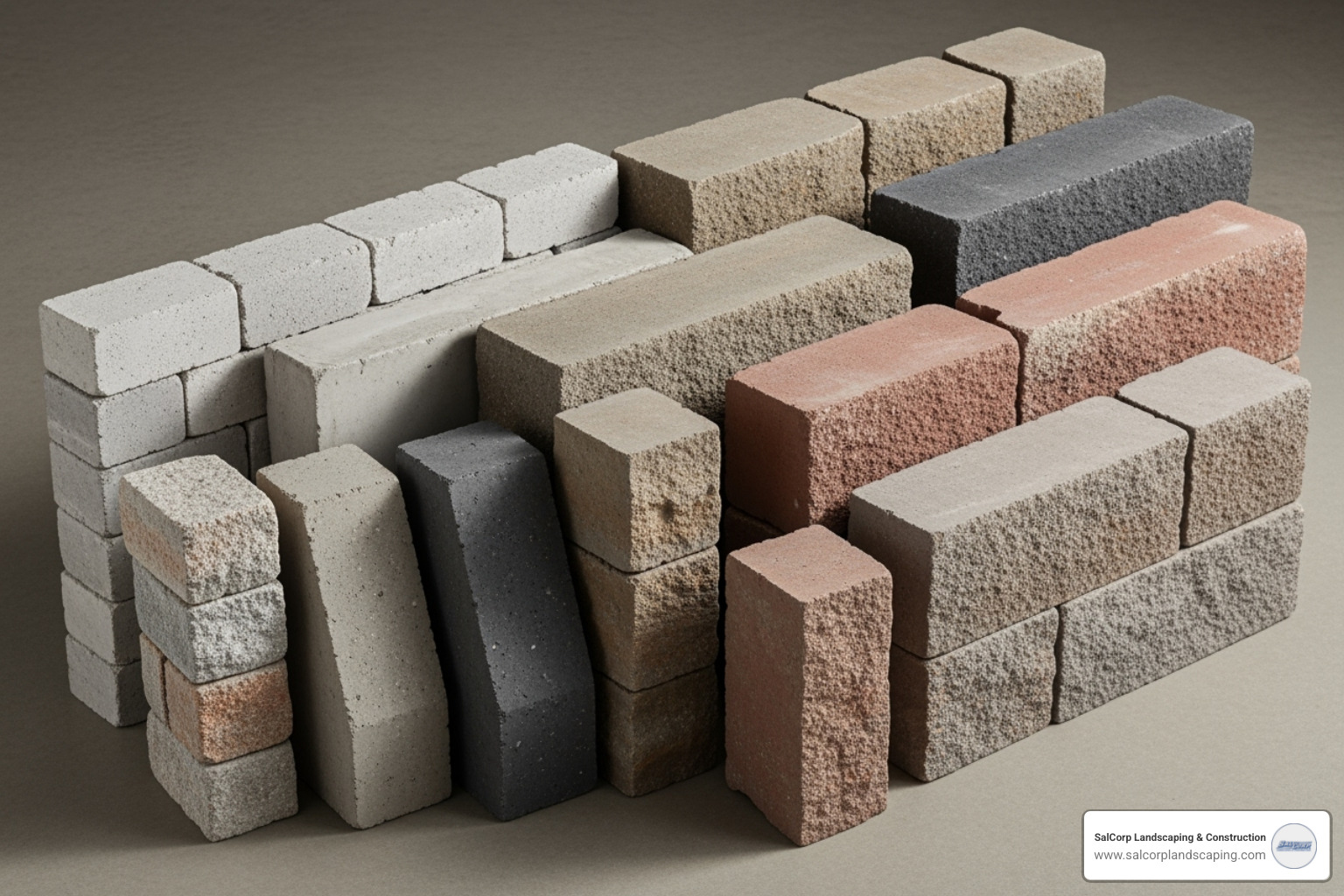
The textures and finishes determine the wall’s aesthetic appeal, with options ranging from natural stone to sleek, modern faces. The choice of Hardscape Material impacts both appearance and structural integrity. We recommend high-quality blocks to ensure longevity.
A Guide to the Top Types of Concrete Retaining Wall Blocks
Understanding the different types of concrete retaining wall blocks is key to any outdoor project. Their modular nature makes construction efficient, with options ranging from DIY-friendly blocks for small projects to heavy-duty solutions for massive earth retention. Our team can help you steer the choices and provide More info about hardscape ideas that incorporate these versatile materials.
Large Precast Concrete Retaining Wall Blocks
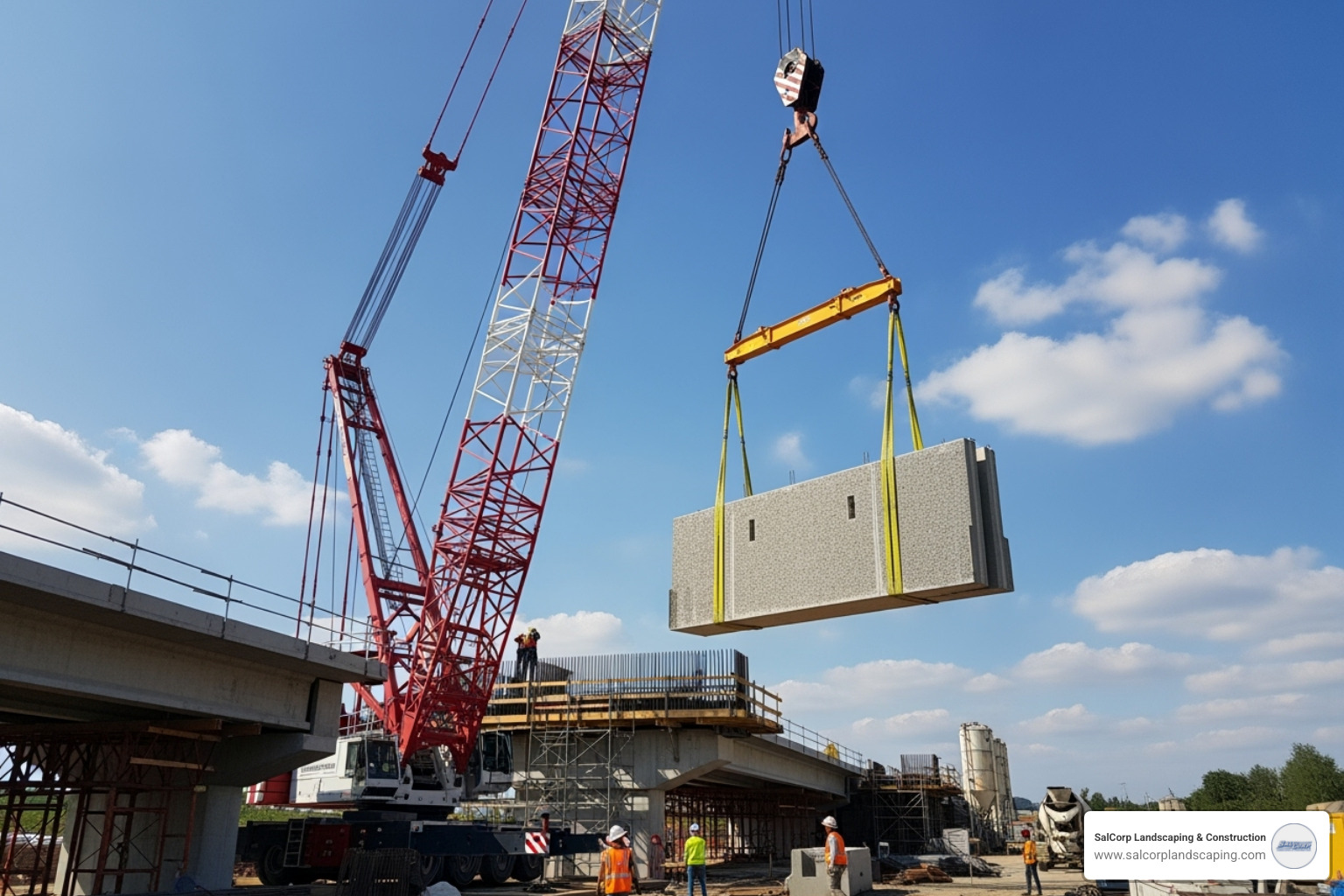
Large precast concrete retaining wall blocks are heavyweights built for immense strength and scale, making them ideal for industrial, commercial, and infrastructure projects. These substantial blocks can weigh up to 4,000 pounds each and require specialized machinery like excavators or cranes for placement. This allows for fast installation with machinery on large projects. Many are designed as gravity wall systems, relying on their mass for stability. Features like built-in rebar rings can simplify handling.
Segmental & Interlocking Concrete Retaining Wall Blocks
Segmental and interlocking concrete retaining wall blocks are the workhorses of residential landscaping. Their DIY-friendly nature and versatility make them the most common for residential use. Segmental Retaining Walls (SRWs) feature an interlocking design (using pins, lips, or keys) that allows for mortar-free stacking, simplifying installation. Their modular nature enables the creation of curves and corners, raised patios, garden walls, and tiered landscapes. While common for shorter walls, proper engineering with soil reinforcement (geogrid) allows them to be built over 50 ft with reinforcement. You can Learn about engineered systems that achieve these heights.
Hollow Core Concrete Retaining Wall Blocks
Hollow core concrete retaining wall blocks are an innovative option offering unique advantages without sacrificing strength. Their hollow design makes them lighter weight, which makes them easier to handle and can lower transportation costs. During installation, the cores are filled with crushed stone to provide mass for stability. This infill also creates excellent drainage properties. Some open-cell designs can be used for plantable “living wall” options, blending the hardscape with the natural environment. Our expertise allows us to recommend the best type of blocks for your needs, and we often discuss options for More info about landscape walls in Hingham MA with our clients.
Planning Your Wall: Installation and Design Essentials
A successful retaining wall requires more than just stacking concrete retaining wall blocks; it demands careful planning and preparation to ensure it is both attractive and durable.
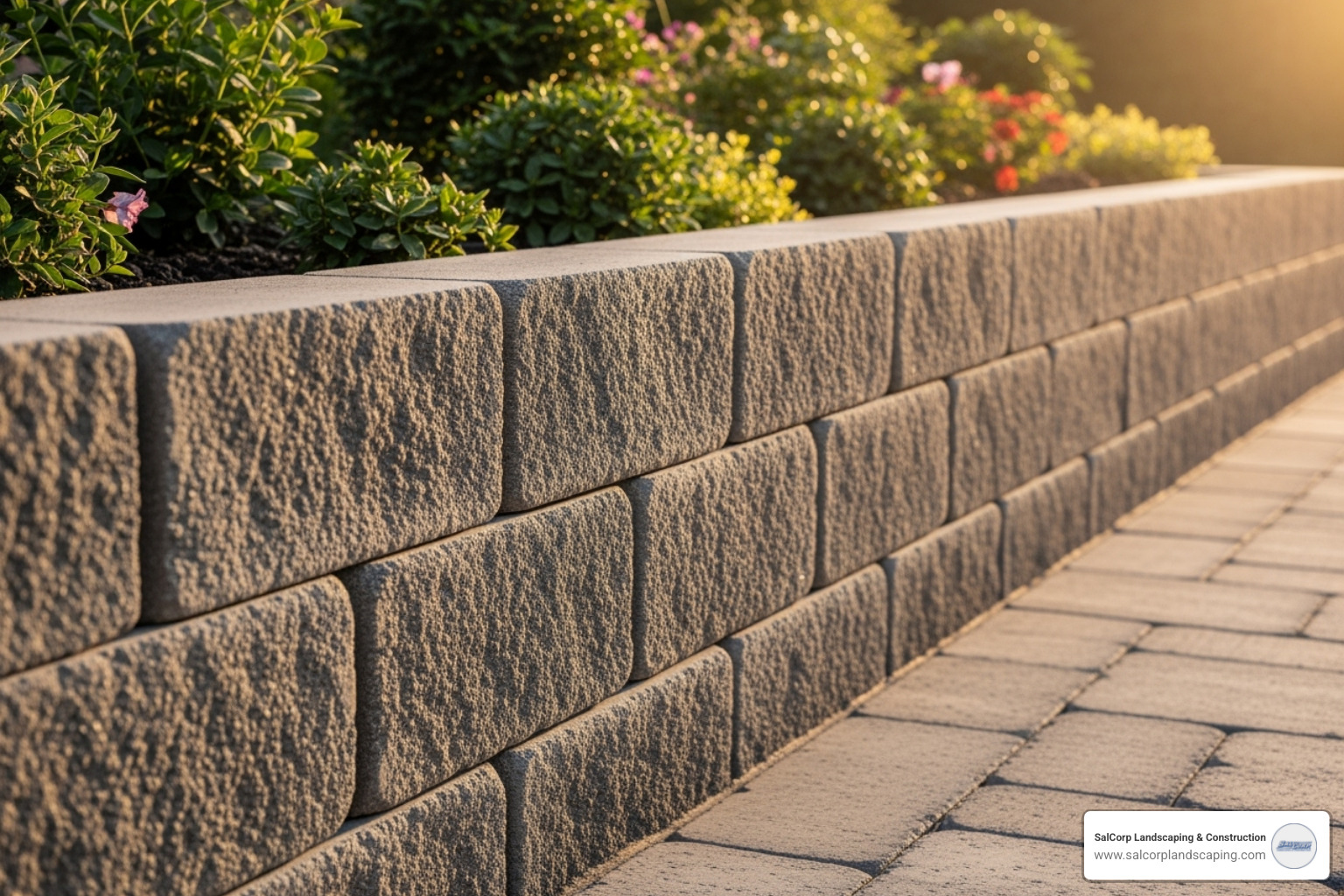
The process begins with thorough site preparation, including clearing, grading, and excavation. The foundation requirements are non-negotiable: a stable, level base of compacted gravel is essential to prevent settling and ensure the wall remains plumb.
Proper drainage considerations are critical to prevent water pressure buildup, which can cause wall failure. A system including a gravel backfill and a perforated drain pipe at the base is necessary to redirect water away from the wall and keep it stable.
Taller walls often require geogrid reinforcement, a synthetic mesh that extends into the backfill, tying the wall to the soil mass behind it for increased stability. This is a key element of professional Retaining Wall Design.
Retaining Wall Systems Explained
When choosing concrete retaining wall blocks, we also select the best retaining wall system for the situation.
Gravity walls rely on the mass of the blocks to resist soil pressure. They are best for shorter walls (typically under 4 feet) and often use heavy, large precast blocks.
Reinforced walls are necessary for taller structures. They incorporate geogrid into the backfill, extending into the soil to create an integrated structure that increases stability and allows walls to reach heights of over 50 feet with proper engineering.
Freestanding walls do not retain soil but stand on their own as decorative borders, garden walls, or seating areas. They typically have a finished look on both sides. Our expertise in More info about hardscape installation ensures the correct system is chosen for your project.
DIY vs. Professional Installation
A common question is whether installing concrete retaining wall blocks is a feasible DIY project. The answer depends on the project’s scale. For small projects like low garden borders (under 3 feet), DIY installation is often feasible. Many segmental systems are designed for homeowners, with interlocking features and manageable weights that allow for dry stacking.
Larger, precast blocks weighing thousands of pounds require heavy machinery like excavators for safe placement and are not suitable for DIY projects.
Any wall over 4 feet high or one supporting a significant load (like a driveway) requires professional engineering. This involves complex calculations for soil pressure, drainage, and geogrid to ensure safety and stability, preventing costly failures.
It is crucial to check local building codes. Most municipalities in Massachusetts have strict permit requirements for retaining walls, especially those over a certain height (often 4 feet). Non-compliance can lead to fines or removal orders.
When should you hire a professional? For any wall over a few feet high, supporting a load, or requiring complex engineering, we recommend hiring experts. As an owner-operated Hardscape Contractor Near Me, SalCorp Landscaping & Construction has the experience and machinery to ensure your project is safe, compliant with local codes, and built to last.
Budgeting for Your Project: What Influences Block Costs?
Budgeting for a retaining wall requires understanding the key factors that influence the cost of concrete retaining wall blocks and their installation. While we cannot provide an exact price without a consultation, this guide will help you understand the elements that affect your budget.
Factors Influencing the Cost of Concrete Retaining Wall Blocks
Several factors determine the final cost of a retaining wall project:
- Block size and weight: Larger, heavier blocks typically cost more per unit due to increased material and manufacturing complexity. However, they can be more efficient for large projects, as fewer blocks are needed and installation with machinery is faster.
- Style, texture, and color: Blocks with premium styles and textures that mimic natural stone, or those with custom colors, will cost more than standard, plain-faced blocks.
- Project complexity: A simple, straight wall is less expensive than a complex design with curves, corners, stairs, or multiple tiers. These designs require more specialized blocks and skilled labor.
- Labor and equipment: Costs vary based on project scale. Small DIY projects have minimal labor costs, while large walls requiring heavy machinery for placement will be more expensive. As a company with its own machinery, SalCorp can manage these costs efficiently.
- Delivery costs: Transporting heavy blocks from the supplier to your property is a significant expense, influenced by order size and distance. A single delivery might hold around 22 standard blocks. For more budgeting insights, see our Related info on patio installation costs.
Average Price Ranges
Disclaimer: The following are broad estimates based on industry data and are provided for illustrative purposes only. Actual costs will vary significantly based on your specific location, chosen supplier, the particular product, and the overall scope of your project. For an accurate and personalized quote for your unique needs, please always contact a professional.
Here’s a general idea of material costs you might encounter:
- Small interlocking blocks: $4 to $20 per block.
- Large precast blocks: $50 to $150+ per block.
- Decorative or custom blocks: $25+ per square foot.
These figures are for the material cost per unit only. The total project cost also includes site preparation, excavation, foundation materials, drainage, backfill, geogrid (if needed), labor, equipment, delivery, and potential engineering and permit fees. We recommend getting a comprehensive quote from an experienced contractor for an accurate budget.
Frequently Asked Questions about Concrete Retaining Wall Blocks
Here are answers to some of the most common questions we receive about concrete retaining wall blocks.
How high can you build a concrete block retaining wall?
Without professional engineering, concrete retaining wall block walls are typically limited to 3-4 feet in height. At this height, the wall’s mass is often sufficient to resist soil pressure. However, with professional engineering and geogrid soil reinforcement, segmental retaining walls can exceed 50 feet. This requires precise calculations to account for soil type and water pressure, creating an incredibly strong, integrated structure.
Our golden rule is to always check local building codes. Municipalities in Massachusetts have specific height limits and permit requirements. Ignoring these can lead to fines or an order to remove the wall.
Do concrete retaining walls need drainage?
Yes, proper drainage is an essential, non-negotiable part of any successful concrete retaining wall block system. Water buildup behind a wall creates immense hydrostatic pressure, which can cause the wall to lean, crack, or fail completely.
A proper drainage system includes several key elements to prevent this:
- Gravel backfill zone: A layer of clean, crushed stone behind the blocks allows water to filter down, relieving pressure.
- Perforated drain pipe: Installed at the base of the gravel backfill, this pipe collects and channels water safely away.
- Geotextile fabric: This fabric separates the backfill from the native soil, preventing clogs in the drainage system.
Even hollow-core blocks with internal drainage must be part of a comprehensive system. Proper water management is key to a wall’s longevity.
Where can I buy concrete retaining wall blocks?
You can buy concrete retaining wall blocks from several sources, depending on your project’s needs.
- Landscape and masonry suppliers offer a wide variety of segmental blocks suitable for most residential and small commercial projects.
- Big-box home improvement stores carry a limited selection of lighter, DIY-friendly blocks for very small projects.
- For specific proprietary systems (e.g., Redi-Rock, Allan Block), you may need to contact a licensed dealer or the manufacturer’s network.
For most projects, the most efficient path is to partner with a professional Retaining Wall Contractor. We have established relationships with top suppliers, allowing us to source the best materials, handle logistics, and ensure a flawless installation, saving you time and ensuring the project is done right.
Transform Your Landscape with the Right Blocks
Choosing the right concrete retaining wall blocks is a crucial step in creating a successful and lasting change in your outdoor space. We’ve covered what these blocks are, the different types available, and how to plan for their installation.
These blocks offer an unbeatable mix of durability, versatility, and aesthetic appeal, making them a top choice for managing slopes, controlling erosion, and enhancing your yard’s beauty and function.
Whether you need heavy-duty precast blocks for a commercial job or user-friendly segmental units for a garden patio, there is a concrete retaining wall block solution. Understanding the differences between gravity, reinforced, and freestanding walls is key to ensuring your project is safe, strong, and built to last.
At SalCorp Landscaping & Construction, we understand that selecting and installing concrete retaining wall blocks can be overwhelming. With over two decades of experience serving communities throughout Massachusetts, from Walpole to Newton, we are here to guide you. As an owner-operated business with our own machinery, we are a trusted partner dedicated to delivering strong, beautiful, and lasting outdoor solutions.
If you’re ready for expert advice and professional installation to transform your landscape, contact us. Our team is ready to help you choose the perfect concrete retaining wall blocks for your property.
Contact a professional retaining wall contractor today!